
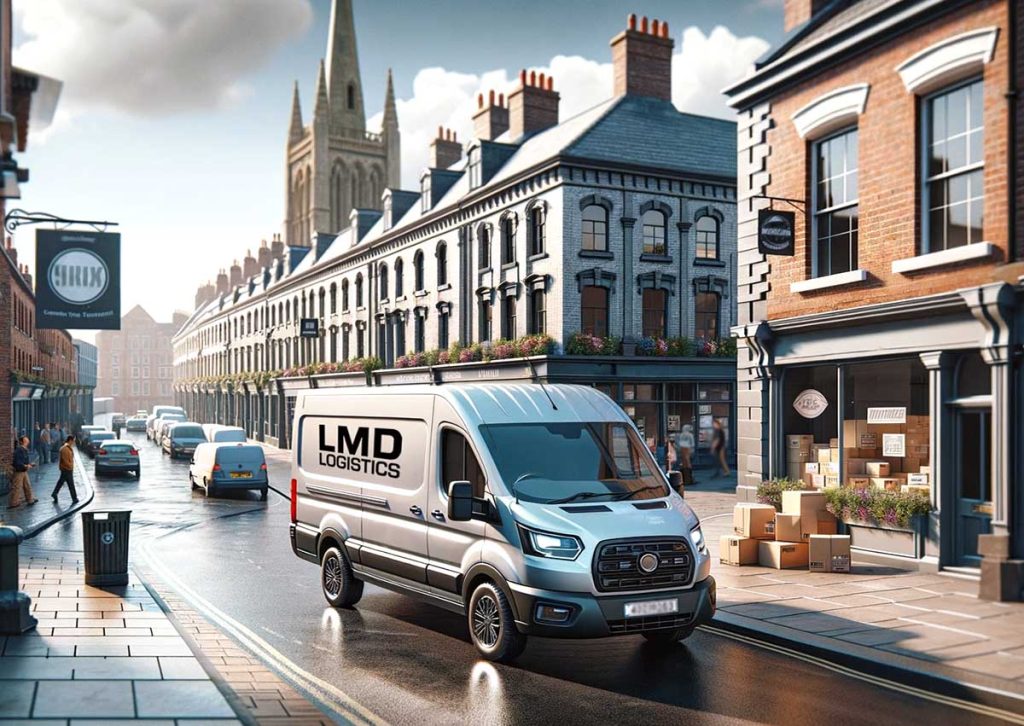
A business removal is a planned move of a working business from one set of premises to another with as little lost trading as possible. Compared with a house move it involves more people who need to be kept informed, more rules at each building, and a hard deadline: the business has to be able to open again at the new address.
LMD Logistics moves offices, shops, cafes, salons and industrial units from our base in Birtley beside the A1(M). This guide walks through what you can expect at each stage, so you know what to prepare and what to ask any mover you are considering.
Stage one: the first conversation
Expect to be asked what the business does, what is moving, the two addresses, and when you need to be open again. For anything beyond a small unit, a walk round of the current premises by video or in person is the most reliable way to size the job. It is also the moment to mention anything unusual: heavy machinery, a safe, glass display cases, refrigerated stock or a server rack.
Stage two: the plan
- The order rooms or departments move in, so the most important ones are up and running first.
- Whether the move happens in one go or in phases over several evenings or weekends.
- Who at the business signs off each area, and who the crew should ask on the day.
- Building access at both ends: lifts, loading bays, parking and permitted working times.
- What goes to storage, what is cleared and what is moving to the new site.
Stage three: preparing the business
The business side of the preparation is mostly labelling and communication. Every box, desk and piece of equipment should carry a label that matches a room or zone at the new premises. Staff should clear personal items from desks and pack their own drawers. IT equipment is usually disconnected by your own IT support before the crew arrives and reconnected after, so the move itself is just the physical transport of hardware, handled with care.
For shops, stock is the difficult part. It is usually best packed by staff who know it, into boxes clearly marked by section, with fragile or high-value lines kept separate and flagged to the crew.
Stage four: moving day or nights
Most business moves are booked outside trading hours. Our commercial work runs in evenings, at weekends and in phases, and the crew works to the plan agreed beforehand. Furniture that needs taking apart is dismantled on site and rebuilt at the other end, and everything is carried out under goods in transit and public liability insurance.
Stage five: the first day at the new site
A good business removal ends with each item in the right zone, desks rebuilt where the floor plan says, and the old premises empty for hand back. It is worth keeping someone from the business on hand at the end of the move to check each area and point out anything that needs shifting while the crew is still there.
Questions worth asking any business mover
- Do you work evenings, weekends and phased moves?
- Can you provide proof of goods in transit and public liability cover to our landlord?
- Can you store items we are not ready to take to the new site?
- Will the same crew handle dismantling and reassembly?
- Can you clear what we are leaving behind at the old premises?
Common questions
Will we have to close to move?
Usually not for long. Business moves are commonly booked in evenings, at weekends or in phases so trading can carry on.
Do you move shops and industrial units as well as offices?
Yes. Our commercial removals cover offices, shops, cafes, salons and industrial units.
Can you store furniture we do not need yet?
Yes. Items can be held in storage at our Birtley yard until the new premises are ready for them.
Related services
- Commercial Removals in Washington — Office, shop and business relocations across the North East — planned around your trading hours.
- Storage in Washington — Short or long term storage at competitive rates with immediate availability.
- Packing Services in Washington — Full or part packing with proper materials, so everything is box ready before the van arrives.
Areas this applies to
- Washington — NE37 / NE38
- Darlington — DL1 / DL2 / DL3
- Newcastle — NE1 / NE2 / NE3 / NE4 / NE5 / NE6 / NE7